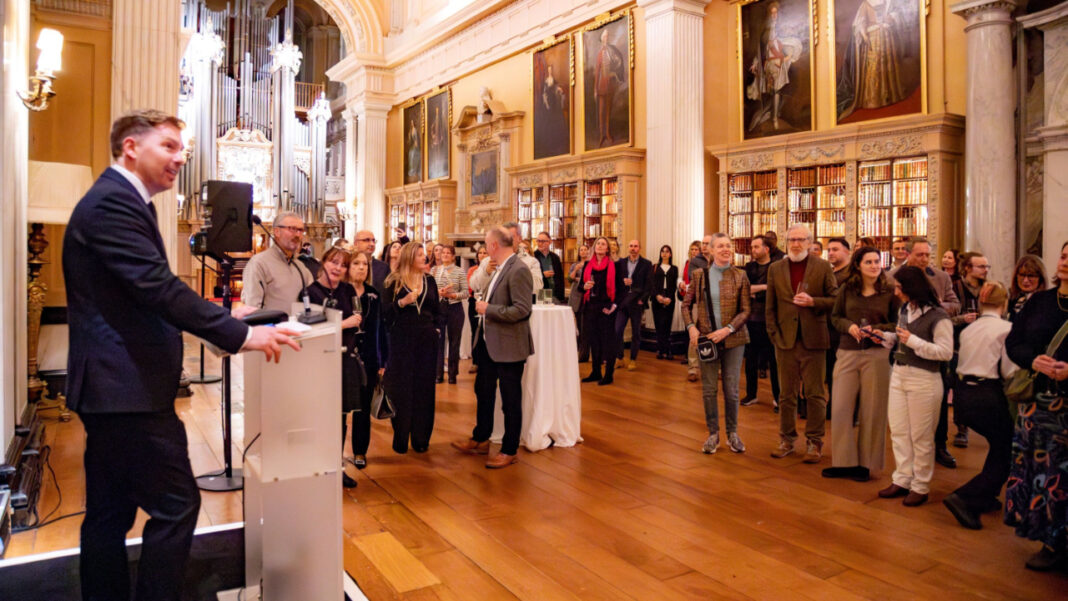
Over 200 cultural heritage and tourism professionals from across Europe gathered at Blenheim Palace last week to mark the end of a groundbreaking European cultural content project, and the beginning of a new era where AI is being used thoughtfully and responsibly to transform visitor experiences.
Britain’s Greatest Palace welcomed attendees from a wealth of countries including Finland, Turkey, Italy and Spain for the final national event of the CULTURATI project, an exciting pan-European initiative that has pioneered the responsible use of artificial intelligence in cultural heritage.
The event brought together leading figures from Oxford University, Oxford Brookes University, DMO Experience Oxfordshire, and cultural institutions from across the continent – including the likes of Rahmi m. Koç Museum (Istanbul) and Porvoo (Finland) – to celebrate three years of innovation and collaboration.
Funded by the European Commission under Horizon Europe and coordinated by Bilkent University (Turkey), the 14-partner consortium brings together computer scientists, cultural professionals, social scientists, SMEs, public authorities, and community organisations to increase accessibility and economic development while preserving Europe’s cultural heritage.
David Green, Head of Innovation at Blenheim Palace, commented: “This final national event celebrates what’s possible when technology and cultural heritage come together with care and vision. We’ve demonstrated that AI, when used thoughtfully and responsibly, can create deeply personal experiences for visitors while addressing critical challenges like sustainable tourism. The CULTURATI project has shown that innovation doesn’t mean losing the human touch – it means amplifying it.”
Rather than marking an ending, participants emphasised that this milestone represents the beginning of a new chapter in how cultural organisations harness AI technology to enrich visitor experiences while preserving authenticity and historical integrity.
One of the project’s most remarkable achievements has been the use of IoT (Internet of Things) sensors to manage crowd capacity and voice cloning technology to bring historical voices back to life. At Blenheim Palace, visitors can now hear Archie Illingworth – the Palace’s beloved former Administrator and first Chief Guide who served from 1950 to 1972 – share fresh perspectives and untold stories from the Palace’s rich 300-year history.
CULTURATI has proven adaptable across both micro and macro-scale sites, demonstrating its versatility from intimate heritage venues to expansive cultural landscapes. The platform’s engine contains thousands of stories curated by over 80 individuals, each offering unique perspectives that enrich cultural engagement while supporting sustainable tourism through intelligent crowd management.
The gathering also included demonstrations of the ‘Archie – your interactive guide’ app, which has revolutionised how visitors explore Britain’s Greatest Palace. Attendees explored how this foundation will grow as technology continues to evolve, with the platform designed to enhance accessibility, awareness, and participation in cultural heritage while making sites more resilient by preventing deterioration from overcrowding.
Representatives from Oxford Brookes University shared research findings on visitor engagement and user experience while DMO Experience Oxfordshire highlighted the broader tourism and economic development implications of AI-enhanced cultural attractions.
The CULTURATI project addresses UNESCO’s call to better support cultural sectors by enhancing collaboration between private cultural and creative industries, public institutions, and communities.