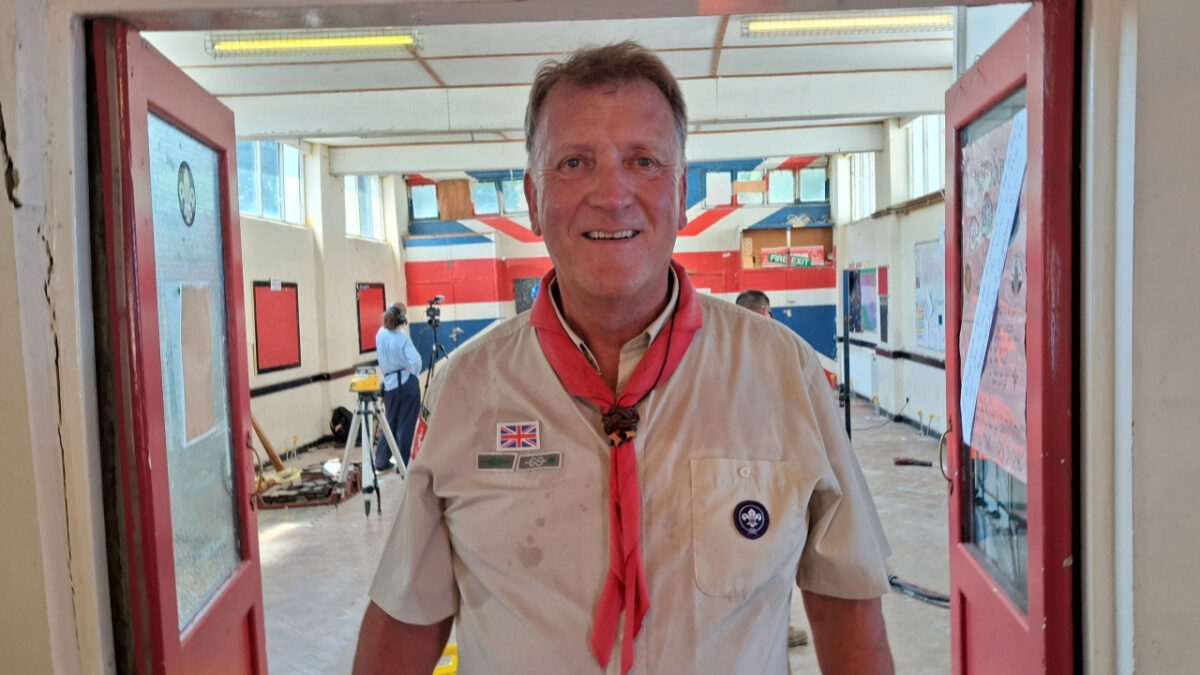
Major ground improvement works across just five days have saved a 1960s Scout hut that seemed to be “splitting in half” with severe cracking on the walls and floor.
The 71 linear metres of foundations at the community building in Dartford, Kent, had experienced foundation settlement over time, resulting in cracking to the walls and loss of ground support beneath sections of the flooring. The Scout group had moved to a different location until the refurbishment was completed.
“The hall was built by the parents and the leaders and they used traditional 1960s building methods, but they didn’t truly understand the nature of the ground underneath,” said Paul Boreham, Group Lead Volunteer & Charity Trustee, 5th Dartford Scout Group. “We had become aware of a number of movement issues including a crack starting at the middle of the floor as if the building is splitting in half.”
Mainmark UK improved the ground and helped re-strengthen the existing structure and prevent further movement. Mainmark utilised its Teretek® engineered resin injection solution to improve the ground beneath approximately 71 linear metres of foundation.
“If we had shut the hall, we would have to close down the group as we would have nowhere else to meet and that would’ve been the end of the Dartford Scout Group after 110 years. We are looking forward to this new lease of life. We have refurbished the hall on stronger ground and we want to carry on scouting here for at least the next 100 years,” Paul added.
The 5th Dartford Scout Group is the longest continuously running group in the District, welcoming hundreds of young people from the ages of six to 18. The Scout hut offers a variety of activities including archery, rifle shooting, climbing and abseiling.
Due to the age of the structure, it meant that construction detailing and varying ground conditions had to be carefully considered during the works. The Mainmark UK team had to minimise disruption to the community facility and had to work efficiently within a five-day period.
Freya Chapman, Residential Lead at Mainmark UK said: “The building had signs of both historic and active movement, which was evident from the damage you could see in the superstructure. We looked at many methods to elongate the lifespan of this building and Teretek was decided upon due to the ground conditions, foundation type and access to the structure.
“Our resin injection is non-invasive and not harmful to the environment. We conducted a series of dynamic cone penetrometer tests at various depths. This information provided us with the depth in which we reached competent strata, this was therefore our treatment depth. The team then drilled to the treatment depth and installed the hallow injection tubes ready for the treatment to take place.
“The structure is monitored with laser levels and data captured. We also had a drainage engineer monitoring the drains throughout the injection process, this was to ensure the drainage network was not damaged during the treatment works,” Freya continued.
Thanks to the resin injection process, the team successfully enhanced the longevity of an existing community asset, eliminated voids beneath the structure and avoided further settlement-related movement. Compared to traditional methods, this process delivered a lower environmental impact and avoided any excavation or removal of existing materials.
Established in the UK in 2016, Mainmark Ground Engineering (UK) Ltd is a subsidiary of the Mainmark group of companies.