A British-German collaboration was announced at Formnext last night that will unlock new additive manufacturing capability for the aerospace, maritime and oil and gas sectors.
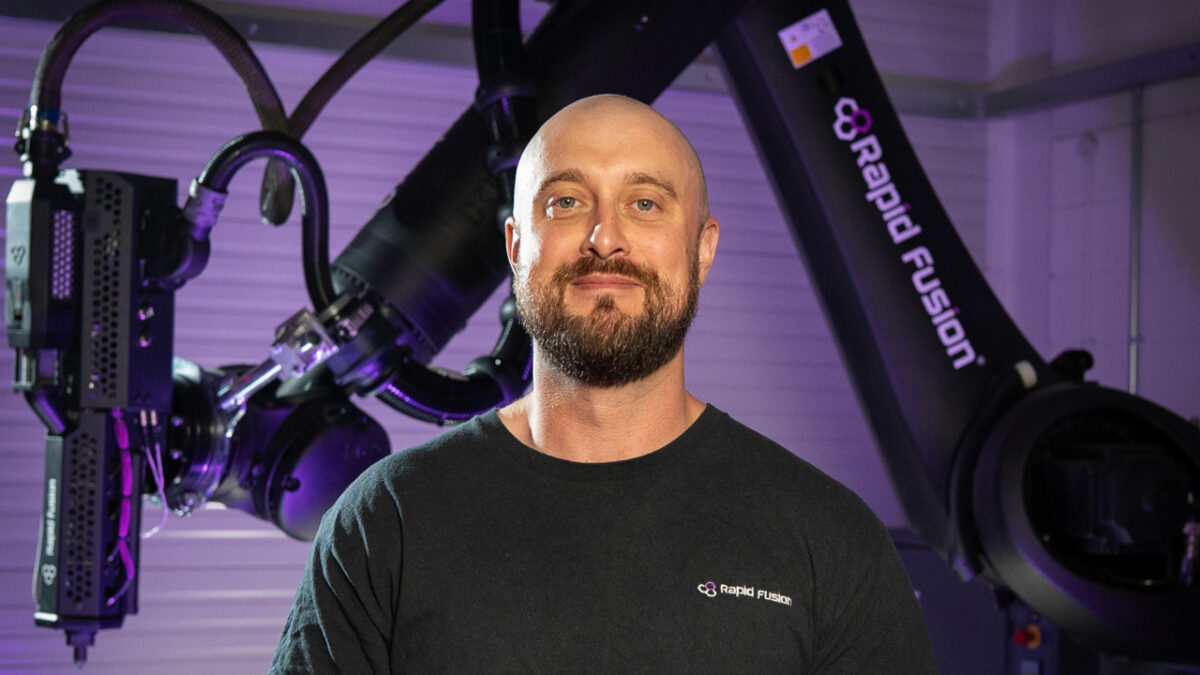
Rapid Fusion, which delivers new tooling and printing solutions from its Skypark HQ in Exeter, will launch its new ‘Prometheus’ robot cell early next year and, for the first time, it will feature state-of-the-art layer adhesion technology from LEAM.
The two companies have built the ecosystem for the machine from the ground up, with a brand-new extruder designed to accommodate the state-of-the-art adhesion nozzle that applies localised heating at the point where fresh material meets the previous layer.
Using a unique temperature sensing process, the heat is controlled as the print progresses to deliver the optimum strength bonding performance.
Bosses at the UK firm already have clients signed up for first deliveries of the cell, which is expected to generate more than £2m in collective revenues over the next two years.
“This international collaboration is a gamechanger in 3D printing, and I don’t say that lightly,” explained Jake Hand, Managing Director of Rapid Fusion.
“Over the years we have developed robotic cells that can deliver unbelievable additive and subtractive machining capabilities in one…now we are integrating the very best in adhesion layering.”
He continued: “What this means is that end users can now 3D print in notoriously difficult materials for Large Format Additive Manufacturing (LFAM) processes, such as PEEK (Polyether Ether Ketone) and PEI (Polyetherimide).
“These polymers offer the highest performance and will be instrumental in delivering the future requirements of clients in sectors ranging from aerospace and oil and gas to maritime and clean mobility.”
Rapid Fusion and LEAM have worked together previously on retrofitting the adhesion layering technology to its cells, but this is the first time the nozzle, sensors and other proprietary tech have been designed in partnership with engineers from both firms spending countless hours analysing integration, ease of use and performance.
As a result of the collaboration, both parties believe they have come up with a solution that fits more power into the same build space, provides greater accuracy and eliminates a lot of traditional printing restrictions.
It also means customers can design products with lighter walls, reduce the volume of material used and even stop the print halfway through to add inserts or adapt the process – flexibility previously unachievable in standard calls.
Dr Patrick Consul, CEO and Co-Founder of LEAM, added his thoughts: “We are really pleased with how the partnership is progressing and what we are collectively achieving for the 3D printing world.
“When it launches, Prometheus should offer the most complete solution yet for structural parts and tooling printed in large format additive manufacturing. Companies will be able to confidently use PEI and PEEK with this process and enjoy world class quality and performance.
“This should reduce volume of material, which is good for the environment, and then you also don’t have the spend associated with certifying new materials as those two high-performance polymers are already certified across all the key industrial applications.
“Finally, clients could also look at using the capabilities of Prometheus alongside other manufacturing disciplines, completely transforming the way they design and produce parts.”
Jake concluded: “When we setup Rapid Fusion we wanted to push the boundaries of what is possible in LFAM and this is exactly what we are doing. Building strategic partnerships with LEAM and other technology specialists in the field is a blueprint we are going to follow as we look to bring new capabilities to market quickly.”