The short answer: every iPhone from the iPhone XS, XS Max and XR onwards supports eSIM. That covers almost every handset sold since 2018. The technology is no niche experiment either. GSMA research claims eSIM smartphone connections will reach 4.9 billion by 2030, equal to 55% of total smartphone connections. If you own a recent iPhone, you are very likely already carrying the hardware.
What an eSIM Actually Is
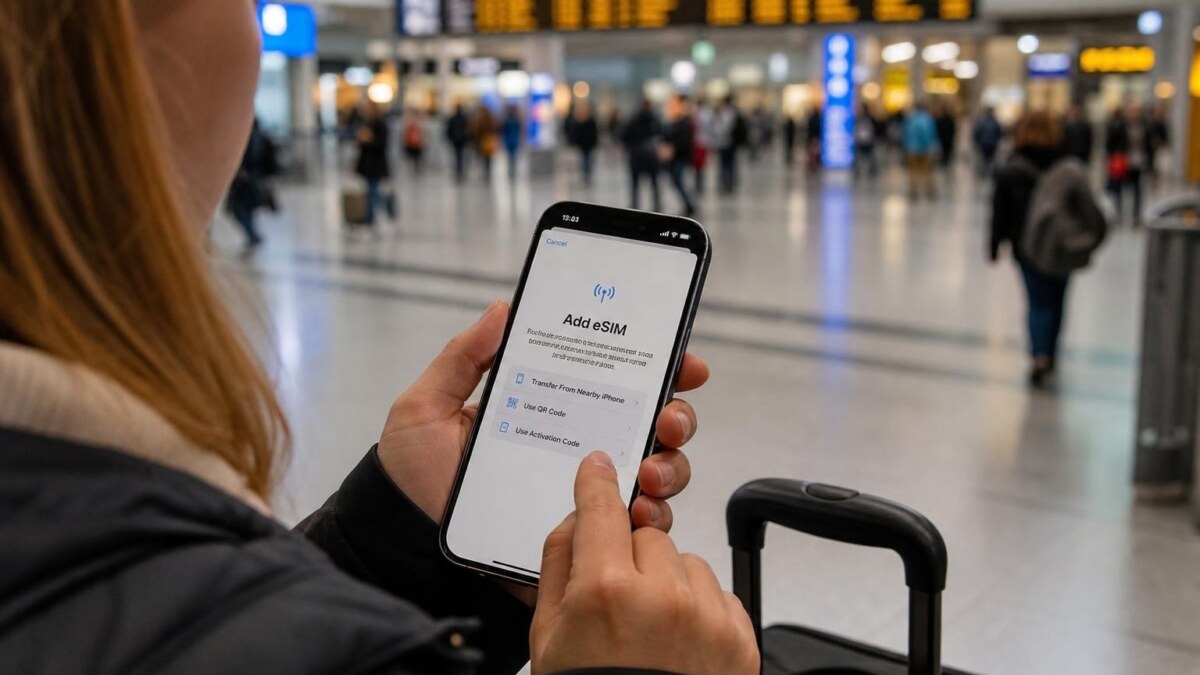
An eSIM is a SIM built directly into your phone. You activate a mobile plan by scanning a QR code or tapping a link, with no plastic card to insert. The chip is reprogrammable, so you can switch networks or add travel data without visiting a shop.
For UK users, the practical benefit is speed. You can buy a data plan online and be connected within minutes, which matters most the moment you land abroad.
Which iPhone Can Use eSIM? The Full List
Here are the iPhone models that support eSIM, sold in the UK and worldwide:
- iPhone XS, iPhone XS Max, iPhone XR (2018, the first eSIM iPhones)
- iPhone 11, 11 Pro, 11 Pro Max
- iPhone SE (2nd generation, 2020) and SE (3rd generation, 2022)
- iPhone 12, 12 mini, 12 Pro, 12 Pro Max
- iPhone 13, 13 mini, 13 Pro, 13 Pro Max
- iPhone 14 and 15 series
- iPhone 16 series
If your iPhone appears above, you are ready to use an eSIM today. No extra accessory is needed.
Which iPhones Do Not Support eSIM
Older models miss out entirely. The iPhone X, iPhone 8 and 8 Plus, iPhone 7 range and every earlier generation rely on a physical SIM only. The original iPhone SE from 2016 is also excluded.
My advice is blunt: if eSIM matters to you and you still use an iPhone X or older, that handset is now the weak link. An upgrade solves the problem permanently.
Dual SIM and Dual eSIM: Know the Difference
This is where buyers get confused, so let me be precise. Most eSIM iPhones support Dual SIM, meaning one physical nano-SIM plus one eSIM active at the same time. That lets you keep your UK number running while adding local data abroad.
From the iPhone 13 onwards, Apple added Dual eSIM. You can store multiple eSIMs and have two active together, with no physical card involved at all. This is the better setup for frequent travellers who juggle several plans.
One Important Note for UK Buyers
UK iPhones still include a physical SIM tray. The eSIM-only iPhone, with no slot at all, is sold only in the United States across the iPhone 14, 15 and 16 ranges. So if you bought your handset in Britain, you keep both options: nano-SIM and eSIM.
This matters when buying a used or imported phone. A US iPhone 14 or later cannot take a physical SIM, which can catch out bargain hunters.
How to Set Up an eSIM on Your iPhone
The process is quick and consistent across supported models:
- Go to Settings, then Mobile Service (or Cellular).
- Tap Add eSIM.
- Scan the QR code from your provider, or use the install link.
- Label the plan, for example “Travel”, then choose which line handles data.
Do this over Wi-Fi before you travel. Setting up at home avoids panic at the airport and guarantees the download completes.
eSIM for Travel: Why It Beats Roaming
Since the end of free EU roaming for many UK networks, overseas charges have crept back. A travel eSIM sidesteps this by giving you a dedicated data plan at local-style rates. You arrive, switch it on, and stay reachable.
For international trips across multiple countries, a single global plan is simpler than buying a new SIM at every border. A multi-country international eSIM from Holafly installs before departure and works the moment you land. The business case for the technology is strengthening too, with UK providers now launching remotely managed eSIM services, as covered in this eSIM MVNO launch report.
Frequently Asked Questions
Can I use an eSIM and a physical SIM at the same time?
Yes. On eSIM iPhones with a SIM tray, you can run one nano-SIM and one eSIM together, keeping your home number live while using data abroad.
Does the iPhone SE support eSIM?
The 2nd generation (2020) and 3rd generation (2022) do. The original 2016 iPhone SE does not.
How many eSIMs can my iPhone store?
Supported models can store several eSIMs. From the iPhone 13 onwards, you can also keep two eSIMs active at once.
Will an eSIM drain my battery?
No meaningful difference. An eSIM uses the same radio hardware as a physical SIM, so battery impact is negligible.
Can I move my eSIM to a new iPhone?
Often yes, using Apple’s eSIM Quick Transfer during setup, or by reactivating with your provider. Travel eSIMs are usually tied to one device, so check first.
The Bottom Line
If your iPhone is an XS, XR or newer, it supports eSIM, full stop. For travel, that chip is one of the most useful features Apple has added in years. Set up a plan before your next trip and you will never queue for a foreign SIM card again.