Most fitness advice for busy people is about squeezing exercise into less time. The 20-minute workout, the lunchtime class and the 6am run all assume the problem is the clock. For most people running a business, the bigger problem is that exercise is the first appointment they cancel.
That’s not a lack of willpower. It’s what happens to anything that only one person is relying on. A solo gym session can always be moved to tomorrow, and tomorrow there’ll be another reason to move it again.
What seems to work for a lot of owners is turning exercise into something other people are counting on. It also helps if it’s fun enough to look forward to. The rise of padel in Britain over the past few years is one of the clearest examples of what that looks like.
Exercise is the first thing to go
People who run their own businesses are generous with their time for everyone except themselves. Insurer Markel Direct surveyed 1,000 UK business owners and sole traders last year. Some 44% said they skip medical appointments or self-care because they’re too busy with work. Over half (57%) often or always work beyond their normal hours, and four in ten said they’d experienced burnout.
The wider population isn’t doing much better. Sport England’s latest Active Lives survey, covering November 2024 to November 2025, found that 64.6% of adults in England meet the government’s activity guidelines. That means at least 150 minutes of moderate activity a week, or 75 minutes of vigorous activity. Almost a quarter of adults, 24.7% or about 11.8 million people, do less than 30 minutes a week.
Nobody needs a survey to know how this goes. The working week fills up, the evening session gets pushed back and a month later the gym membership is a direct debit and nothing more.
Why the efficient options don’t stick
The usual answer is to make exercise smaller. If an hour is too much, try 20 minutes. If the gym is too far, work out at home. These are sensible ideas, and for some people they work.
But they solve the wrong part of the problem. A 20-minute workout is just as easy to skip as a 60-minute one when nobody else knows whether you did it. The decision to exercise still has to be made alone at the end of a long day. It falls to someone whose job is already full of decisions.
What tends to survive a busy diary is anything with other people attached to it. Business owners rarely miss a client meeting, because someone is waiting for them. A booked game works the same way. Cancelling on three friends an hour before the start feels nothing like deciding not to bother with the treadmill.
Enjoyment matters too. Plenty of adults who say they hate exercise mean they hate the dutiful kind, the counting of reps and minutes. Put a ball in front of the same people and the minutes stop being the point. They’re running about because they want to win the next rally.
What padel’s rise says about how adults want to exercise
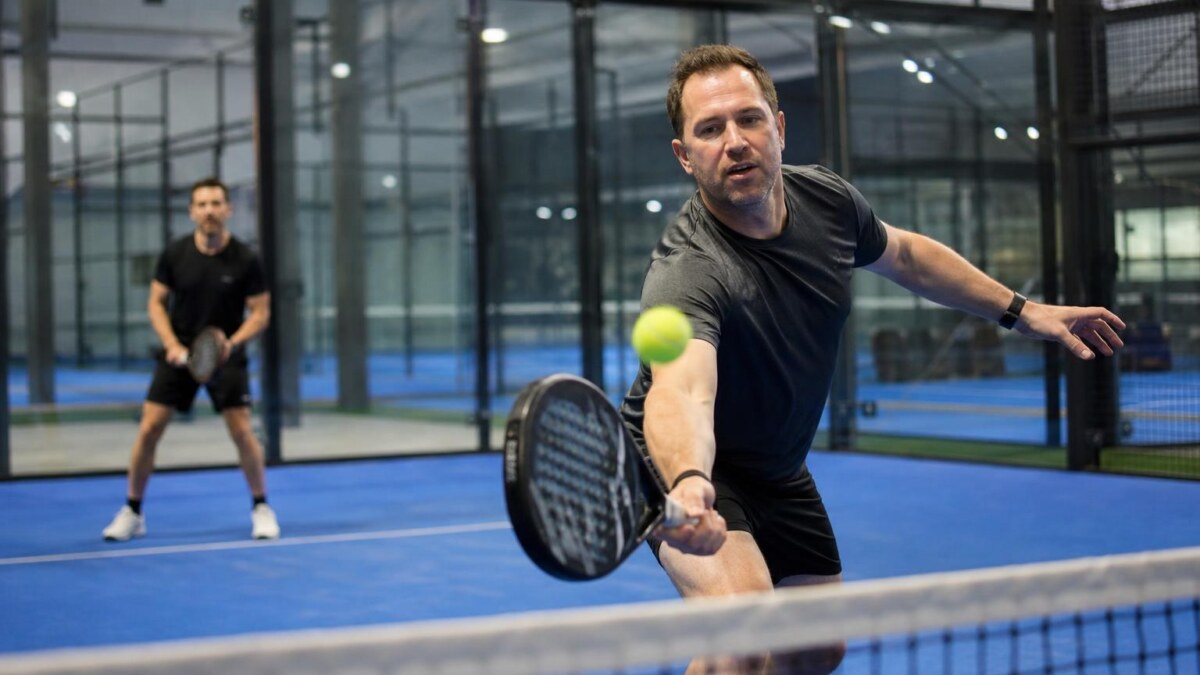
Padel is a racket sport played in doubles on an enclosed court smaller than a tennis court. The walls are part of play, the serve is underarm and the rackets are short and solid. Rallies keep going even when nobody on court is much good, which is a large part of its appeal.
Its growth in Britain has been startling. In 2019 the Lawn Tennis Association (LTA) counted about 15,000 padel players. By October 2026 it put the figure at 1.5 million adults and juniors, playing on 2,445 courts at 682 venues. Tom Murray, the LTA’s Head of Padel, says the sport “has firmly established itself as one of the country’s fastest-growing sports.”
The figures don’t explain why so many adults have taken to it, but the game’s design offers some clues. It’s always played as a four, so every game is a small social arrangement. A beginner can usually get a rally going in the first session. That takes away the embarrassment that keeps many adults away from a new sport. And a game fits into an hour or so, booked in advance like any other appointment.
That combination is exactly what the efficient workout lacks. Padel isn’t the only sport that offers it. Its rise shows how many adults will turn up when exercise feels like a game with friends, not a chore on a list.
The game that doubles as a meeting
For people in business, there’s a second benefit that’s easy to overlook. Running a business can be lonely, and much of the contact owners have with other people is transactional. A weekly game puts them in a room, or on a court, with people who want nothing from them except a decent return of serve.
It can also become part of how they work. Golf has long been where deals get talked through, but a round takes half a day. A game of padel takes about an hour and a bit of chat afterwards, which suits owners who can’t give up a whole afternoon. A regular four with a supplier, a client or a fellow owner builds the kind of easy relationship that’s hard to create across a desk.
Teams can benefit in the same way. A monthly game for staff gives people who sit in different rooms something to talk about that isn’t work. Because padel is quick to pick up, it doesn’t split the office into the sporty few and everyone else.
None of this needs to be dressed up as wellbeing policy. It works because it’s fun, and because people keep doing things they enjoy.
Finding a game that fits
The practical barrier is often just knowing where to play. Courts have opened quickly, at places such as tennis clubs, gyms and leisure centres, so there may well be one closer than people expect. Padel Cover, which designs and builds canopies for padel courts, keeps a map of padel courts across the UK. It can be filtered by indoor, outdoor and covered venues.
For someone starting from nothing, the first step can be as small as booking one court and asking three people along. Plenty of venues run beginner sessions and social nights where players are matched with others at a similar level. That takes care of the other common worry, which is not knowing anyone who plays.
Padel won’t suit everyone, and it doesn’t need to. Walking football, five-a-side, a running club or a weekly tennis four all work on the same principle. What they have in common is a fixed time, other people expecting you and a game that’s enjoyable for its own sake.
Stop trying to find the time
The advice to “make time for exercise” assumes owners are short of minutes. Most of them are short of reasons to protect those minutes from everything else that’s competing for them.
A game booked with other people provides that reason. It turns exercise from a private intention into a shared plan. It also makes the hour something to look forward to rather than something to get through.
The 1.5 million people now playing padel in Britain didn’t all find spare time in their diaries. Many of them found a game they wanted to turn up to. For anyone running a business, that’s a better place to start than another 20-minute workout that gets skipped.