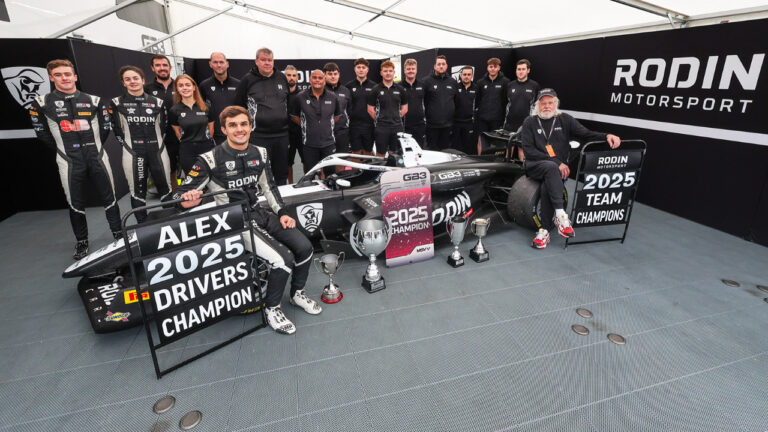
A motor racing team that has had the likes of George Russell, Sebastian Vettel, Daniel Ricciardo and Lando Norris pass through its garage is tapping into the latest integrated CAD solution to increase car performance.
Rodin Motorsport, which employs 60 people at its headquarters in Farnham in Surrey, is using a near 20-year relationship with PTC to shave valuable milliseconds off lap times.
One of the most striking examples came when the ambitious firm leveraged the design and analysis power of Creo to optimise the aerodynamics of a previous-generation FIA Formula 3 Car.
Held on Macau’s Guia Circuit, the event presented a complex engineering challenge with the unique street track winding through the city’s narrow roads and along its waterfront.
Tight, technical sections demand downforce, but the 1.2 km main straight rewards low drag.
Because the category is tightly regulated, the company wasn’t allowed to make new rear‑wing parts, so it could only adjust the existing pieces within small, legally permitted limits and natural variations that occur as those parts wear over time.
“Design is ultimately about finding lap time – improving performance, increasing driver confidence and extracting every advantage regulations allow,” said Benn Huntingford, Sporting Director at Rodin Motorsport.
“The challenge at Macau was finding the right compromise between downforce for the twisty sections and drag reduction for the straight, within the strict FIA limits – and this is where PTC came into the equation.”
Rodin Motorsport first created a detailed 3D model of the rear wing in Creo, then used the software’s industry-leading Flow Analysis to capture pressure distributions across the mainplane and flap, and Creo Simulate to translate those pressures into downforce and drag values for both DRS states.
This allowed the team to understand how air would flow around the wing and how that airflow would affect overall balance, grip and straight‑line speed.
Giving engineers a single environment to optimise aerodynamics and strength simultaneously accelerated development and improved on‑track correlation. The result was faster decisions, fewer redesigns and components that behave exactly as the data predicts when the car hits the circuit.
Once the main model was ready, the team tested ten wing‑flap angle variations in half‑degree increments. Because everything was set up inside a single integrated environment, each scenario only took around 15 minutes to generate, enabling rapid comparison across the full range of options.
“Without Creo, this would have required building physical parts, booking wind tunnel time and re‑running the test for every minor adjustment,” added David Brown, Technical Director at Rodin Motorsport.
“Instead of ten iterations in an afternoon, we’d be facing days or weeks. Creo allowed us to analyse every half‑degree change with both open and closed DRS.”
The Rodin team then fed drag and downforce outputs into a lap‑time simulation tool to determine whether gains on the straight would outweigh the loss in cornering performance.
Their analysis showed that increasing the flap angle by just half a degree slightly reduced grip but also reduced drag, helping the car travel faster on Macau’s long straight. When they combined this information with lap‑time simulations, it became clear that the extra straight‑line speed could more than make up for the small loss of cornering performance.
“Everything comes back to improving lap time,” said Huntingford. “Our lap simulation indicated a potential improvement of up to 0.25 seconds, which is significant when every fraction of a second counts.
“Working with PTC has helped us to give drivers a more responsive, more tuneable car, and that builds confidence and performance, which wins races.”
Creo’s combination of 3D modelling and built‑in simulation has transformed the speed at which Rodin Motorsport develops engineering solutions, predominantly because the analysis lives alongside the model and better decisions can be made between races.
Paul Haimes, VP, EMEAI Solutions Consulting at PTC, added his support: “The power of Creo brings together design, analysis and simulation in one immersive environment and, for a team like Rodin, this means faster, more cost-effective iterations that, importantly, deliver faster lap times.
“From an engineering perspective, it also supports the development of younger engineers who can easily work with reusable templates and shared models, creating a consistent approach across all seven of its racing teams.”
Rodin Motorsport is expanding into new categories while continuing to scale its integrated design and simulation approach.
The team has added the Formula Regional European Championship to its 2026 racing schedule and will also enter GT racing. It is extending Creo access to a wider group of engineers, connecting designs directly with in‑house additive manufacturing for pit equipment and fixtures.