The Advanced Research + Invention Agency (ARIA) has awarded Scalable Laser Limited a £5.3 million contract under ARIA’s Enduring Atmospheric Platform (EndAP) programme. Joined by its partners at the University of Glasgow and Durham University, Scalable Laser will develop Livingston, a revolutionary laser power beaming system able to provide 24/7/365 electricity to EndAP customers.
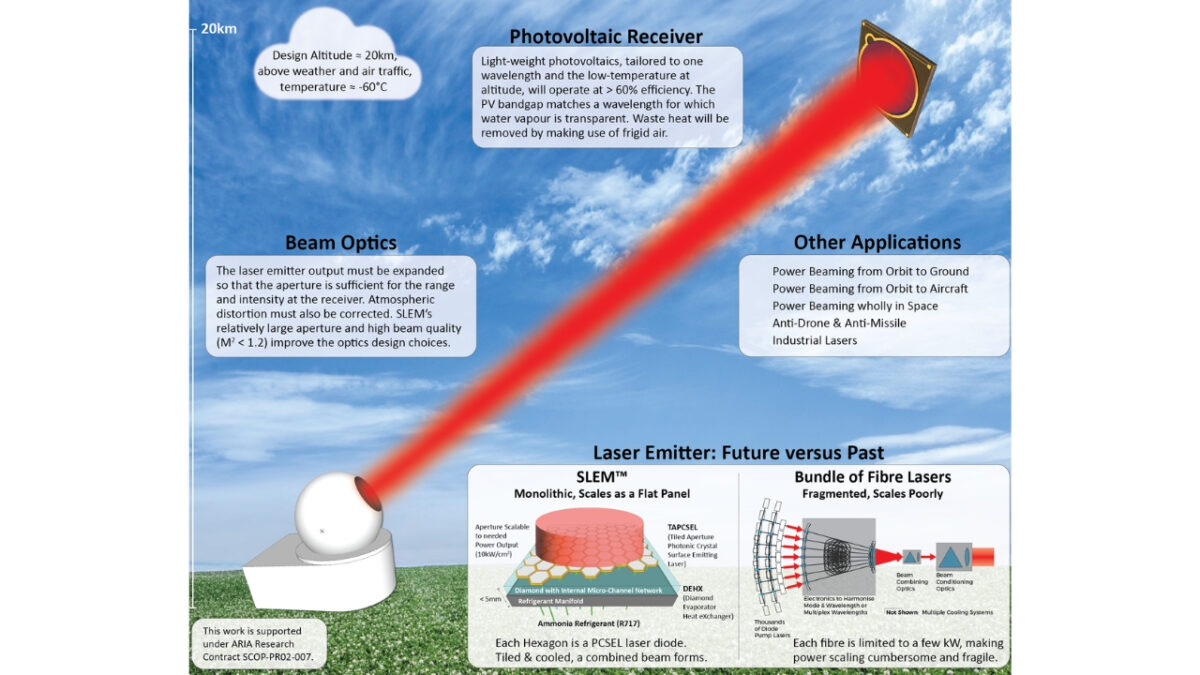
Laser power beaming is a technique whereby the power line between grid and customer is replaced by a laser beam. Electricity is converted to laser light, projected to a photovoltaic receiver attached to a customer’s asset, and converted back into electricity. With laser power beaming, a platform aloft in the stratosphere can be powered indefinitely.
In Livingston, a flat-panel, power-scalable laser is projected through beam expander optics that correct for atmospheric distortion onto a high-efficiency photovoltaic, tailored to the laser’s wavelength, and incorporated on a stratospheric platform up to 25km distant. Scalable Laser is developing the flat-panel laser, the University of Glasgow the photovoltaic receiver, and Durham University the optics. All three components are revolutionary, making Livingston a game-changing capability.
Scalable Laser Limited is a startup founded by Prof. Richard Hogg and Dr Charles Polk to develop the Scalable Laser Emitter (SLEM™), our flat-panel laser. In SLEM, laser tech invented at Aston University by Prof. Hogg is combined with cooling tech invented by Dr Polk. Our registered office is in Birmingham, our workshop in Sheffield. Prof. Hogg is the principal investigator for the Livingston project.
The University of Glasgow will leverage its internationally recognised expertise in photonics, compound semiconductors and nanotechnology to develop high-efficiency laser power convertors for the Livingston project. Led by Prof. Stephen Sweeney, the Glasgow team will create advanced photovoltaics to enable wireless power delivery for EndAPs.
Durham University’s Centre for Advanced Instrumentation (CfAI) is a world-leading research group developing advanced scientific instruments and optical technologies. For Livingston, the CfAI team, led by Dr Cyril Bourgenot, will develop the front-end optics that direct the high-power beam to the photovoltaic converter on an EndAP. The system will use Adaptive Optics to continuously correct for distortions caused by thermal effects and atmospheric turbulence.
Led by Programme Director Rico Chandra, ARIA’s Enduring Atmospheric Platforms programme is backed by £70 million over 3.5 years. 18 funded teams (R&D Creators) are working on technologies to allow aircraft to operate reliably and cost-effectively in the stratosphere, providing the physical backbone for next-generation advanced communications and a path to connectivity for underserved regions.