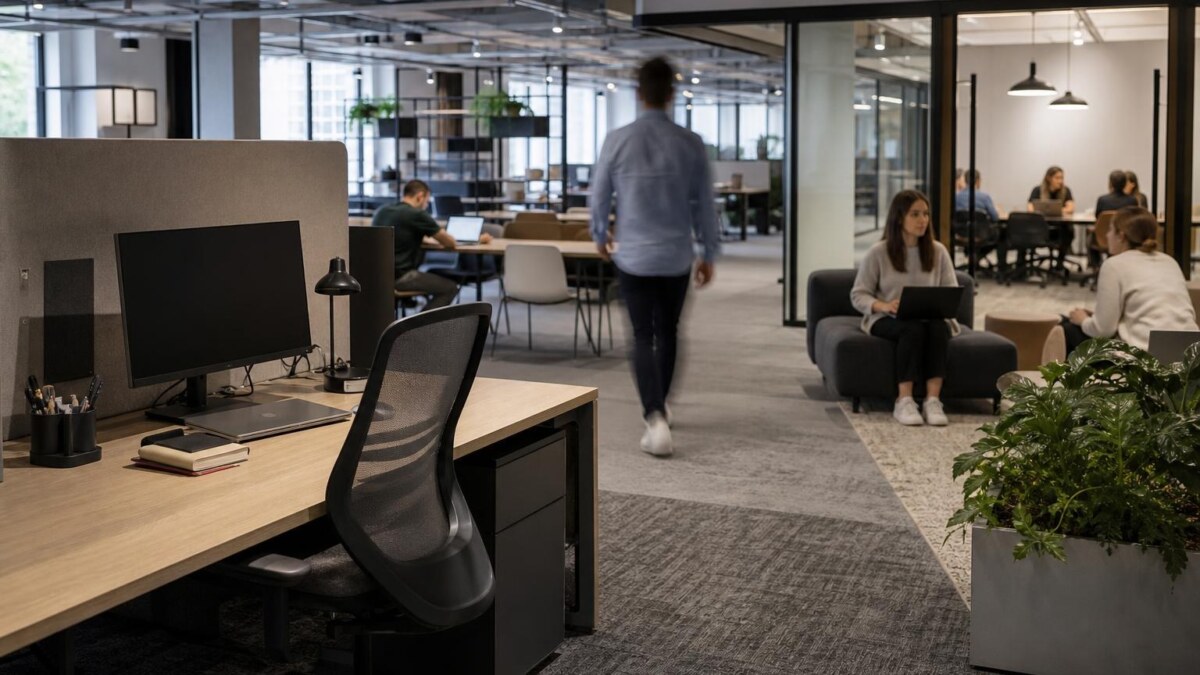
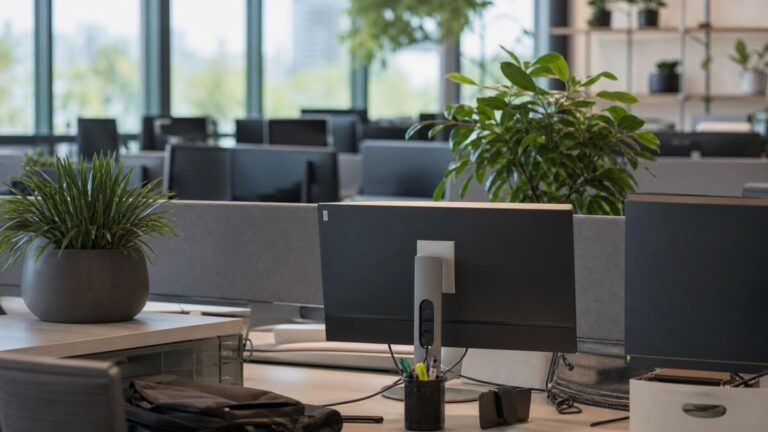
Somewhere in your building there is a desk with your name on it. A monitor, a drawer of stationery, a chair set to your height. And for most of the week, nobody is sitting in it.
That is the uncomfortable arithmetic of the modern office. Businesses are still paying rent, rates, heating and cleaning on floors of desks that stand empty most days, while the one thing the office is now good for, bringing people together, gets whatever space is left over.
The fixed, assigned desk was built for a world where everyone turned up five days a week. That world has gone. The desk has not caught up.
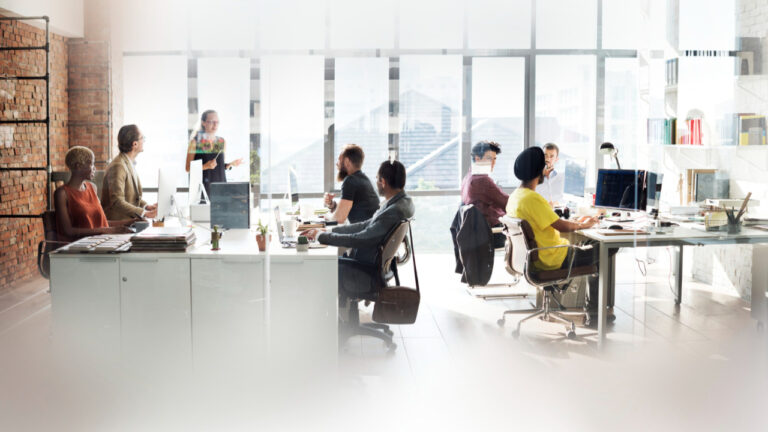
The numbers are stark. CBRE’s 2026 global workplace research puts average office utilisation at around 53%, up from 38% two years earlier, but still meaning that roughly half of all that leased space is empty on any given day. JLL puts two thirds of office workers in the building one to four days a week rather than five, which turns one desk per person into a guarantee of waste. Attendance peaks from Tuesday to Thursday and thins either side, so the average assigned desk now spends more of its life storing a chair than holding a worker.
None of which means the office is finished. It means its job has changed.
“The office is no longer a place or a process, it’s an experience,” argue workplace futurists Philip Ross and Jeremy Myerson in their book Unworking. People are not coming in to sit at a desk they could have used at home. They come in for what a screen cannot deliver, and the research is consistent: collaborating with colleagues is now the single most common reason people give for making the trip.
So the fixed desk starts to look less like a neutral default and more like a strategic mistake. If the reason to be in the office is other people, then an acre of identical single-occupancy desks is space spent on the one activity that never needed the office in the first place.
The businesses pulling ahead have stopped planning around headcount and started planning around activity. You can see the shift across the activity-based and agile office design now replacing rows of desks.
Design around what people do, not how many they are
The alternative to one desk per person is not a smaller version of the same thing. It is a different model altogether.
Activity-based working gives people a range of settings and lets them pick the one that fits the task. A booth to concentrate in. A table to solve a problem together. A screened spot for a call. A social space for the looser conversations where a surprising amount of an organisation’s real work gets done. Agile, modular layouts and reconfigurable furniture mean the same floor can be desks in the morning and an all-hands in the afternoon.
The part that tends to get missed is the commercial one. Because activity-based working cuts the reliance on fixed, individual desks, a business can use its floorplate far more efficiently, handing more room to collaboration and focus without taking on another square foot. Done well, it is one of the rare moves that improves the workplace and lowers its cost at once.
It also treats people as individuals rather than interchangeable units. Kay Sargent, global director of workplace at the design firm HOK, frames good design around three things an assigned identical desk takes away: “options, choice and control.” A junior developer who needs deep focus and a sales lead who lives on the phone have nothing in common except, under the old model, the same desk.
Design for the work, and you stop pretending they do.
Less space, better used
For a smaller or growing business, this is where it really lands. A start-up counting every pound does not need more desks. It needs a space that works harder.
Designing around activity lets a company take less floor and get more from it, then flex as the team changes, adding a project room or turning a bank of desks into collaboration space without a costly refit every time headcount moves. That is a world away from the conversation most leaders are used to having about the office, which tends to begin and end with cost per square foot and desks per floor.
The better question is what the space is for and whether it earns its place. An office sized to how a team really works, rather than to a headcount that was out of date the day the lease was signed, is cheaper to run and more useful to be in.
When attendance drops, the reflex is to argue about mandates, or to hand back a floor and hope for the best. Both treat the office as a fixed cost to be trimmed. The opportunity is to treat it as an asset to be designed.
The office is a decision, not an overhead
The fixed desk lasted as long as it did because it was simple and because nobody had to justify it. Every person, one desk, done.
That simplicity has become expensive. The office that works in the hybrid era is the one built around what brings people in, designed for the range of things they do when they arrive and sized to reality rather than to a spreadsheet of names.
The desk is not coming back as the centre of it. The businesses that see the change coming, rather than paying to heat empty workstations until a lease event forces their hand, will spend less and end up with a workplace people choose to use. The rest will keep wondering why the car park is full and the good ideas are not.