For many entrepreneurs, starting a business is supposed to create freedom.
The reality is often very different.
According to recent research, one in three UK SME owners says their business is pushing them to the brink of exhaustion. Long hours, mounting responsibilities and constant pressure have become an accepted part of business ownership, particularly for founders trying to grow companies in an increasingly challenging economic climate.
But according to business scale-up expert Peter Boolkah, the problem isn’t simply workload.
It’s the way many businesses are built.
“Most business owners become trapped inside the companies they create,” says Boolkah, who has spent more than two decades helping businesses grow and scale. “They start the business seeking freedom, then gradually become the person on whom every decision, process and problem depends.”
Boolkah, a former senior operations leader with McDonald’s UK, believes this founder dependency is one of the biggest barriers to growth facing UK businesses.
“When everything relies on the owner, growth eventually stalls,” he says. “The business becomes harder to manage, stress levels increase, and the owner finds themselves working longer hours simply to keep things moving.”
The issue is particularly common among ambitious entrepreneurs. In the early stages of a business, founders often wear multiple hats, handling sales, operations, finance, recruitment and customer service themselves. While this approach can help get a business off the ground, it can become a significant obstacle as the company grows.
“The skills required to start a business aren’t necessarily the same skills needed to scale one,” says Boolkah. “Many founders struggle to make that transition.”
One entrepreneur who learned this lesson early was Essex businessman Ray Jarvis.
Jarvis left sixth form at 17 and was struggling with dyslexia when he first encountered Boolkah at a business workshop. Rather than offering motivational slogans or quick-fix solutions, Boolkah challenged him to rethink how businesses operate.
Instead of focusing purely on sales growth, Jarvis concentrated on developing systems, improving decision-making and creating structures that allowed his businesses to function without relying entirely on him.
The approach proved successful. He went on to build and sell several companies, including a recruitment business that achieved turnover exceeding £55 million.
Jarvis believes one of the most valuable lessons he learned was that sustainable growth requires founders to stop trying to do everything themselves.
“Learning how to solve problems was more important than being given answers,” he says. “That’s what allowed the businesses to grow.”
Business experts increasingly warn that founder burnout represents more than a personal wellbeing issue. When owners become overwhelmed, productivity suffers, decision-making deteriorates and growth opportunities can be missed.
For smaller businesses in particular, the risks are significant. If the owner becomes unavailable, many firms have no systems in place to continue operating effectively.
The question, says Boolkah, is one every business owner should ask themselves: could the business continue functioning if they stepped away for a month?
“If the answer is no, that’s often where the real work needs to begin.”
As economic pressures continue to mount, many founders are looking for ways to improve efficiency without sacrificing growth. Increasingly, experts argue that the solution lies not in working harder, but in building businesses that are less dependent on the people who created them.
For many entrepreneurs, that may be the difference between building a successful company and becoming trapped inside one.
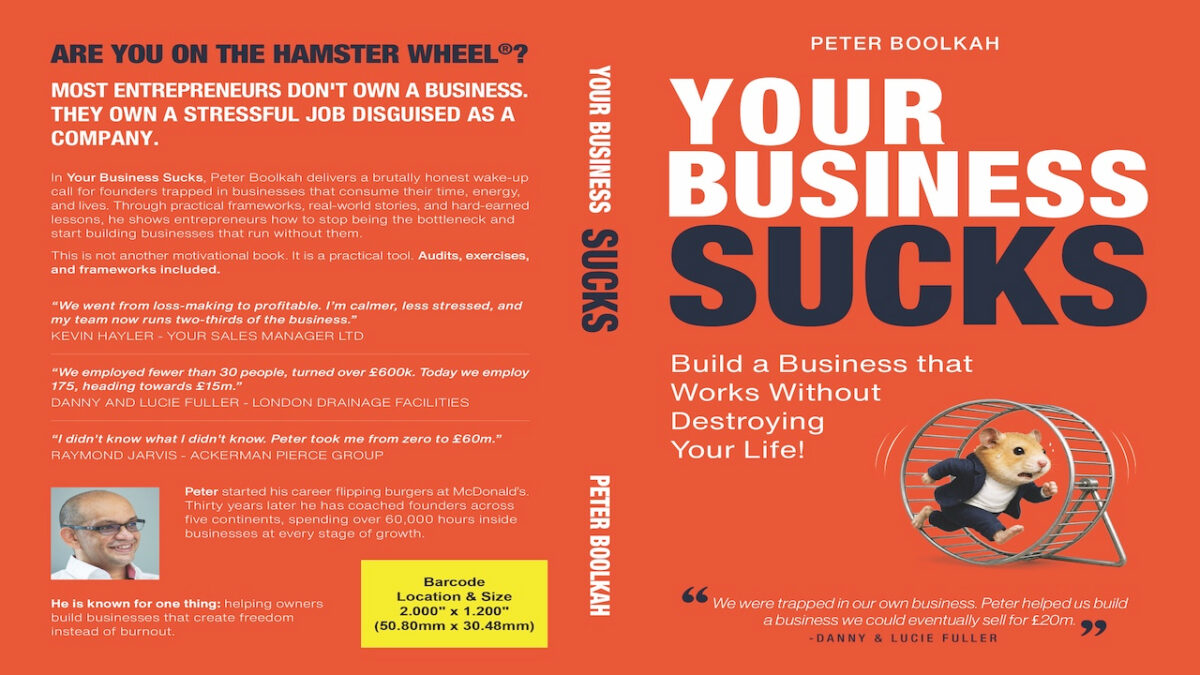
Boolkah’s new book, Your Business Sucks: Build a Business Without Destroying Your Life, expands on these themes, offering business owners practical tools, assessments and real-world examples to help them build more resilient, scalable businesses. Featuring lessons from entrepreneurs including Ray Jarvis, it aims to help founders break free from the cycle of burnout and create businesses that work for them, rather than the other way around.